High Gas Prices. Who's to Blame?
- May 26, 2022
- 6 min read
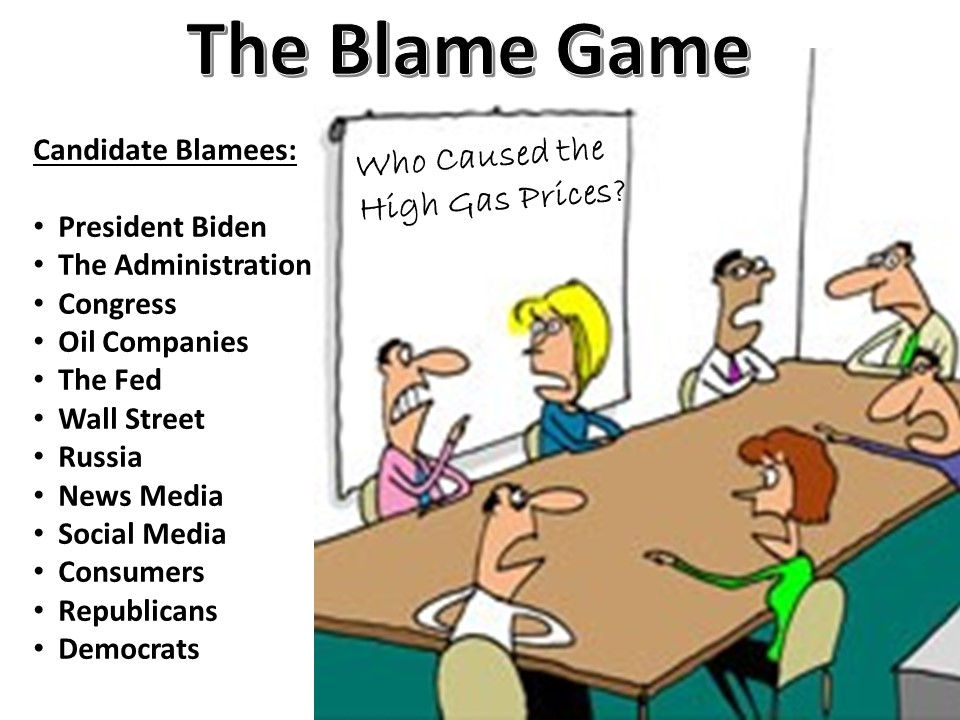
US gasoline prices are way too high.
How exactly do we know this? Well, it’s obvious, isn’t it? Everyone says that gas costs too much. It is causing consumers problems. More of their income is going to paying for gas; either directly, indirectly, or both. This is as bad as gas prices have been in over 40 years. Who’s to blame?
This ‘blame’ question may be more important than the problem everyone is so focused on. After all, we live in a very rational and “cause and effect” world. Things don’t just happen without some reason (cause) behind them. Things like gas prices are all part of the economic system which responds to the conditions which underly our understanding of economics. So, we should be able to make some sound and reasoned connection(s) between the ‘causal’ factors to a logical attribution about whom is to ‘blame’. Blame after all means to be responsible for, to have ‘caused’ the thing that we are looking for accountability for. Well, that’s what ‘blame’ should be based upon rather than perhaps some desperate, fearful, and needy impulse to find some release for an emotional reaction devoid of reason, logic and judgement.
Perhaps a brief test would help provide some insight into this question of ‘blame’.
Question 1: Consumer Demand is to blame. Supply just cannot meet that Demand. So, is this just a case of too many people willing to pay more?
Question 2: Inflation has made gasoline just unnaturally high. So, is the inflated price of today’s gasoline just very out of line with what consumers have paid over the past several decades?
Question 3: Given the persistent Consumer Demand continuing even as gasoline prices increase, is the oil production side (Supply) ramping up to meet that Demand as the Supply-Demand economic model predicts?
Question 4: The high cost of gasoline is due to the government’s actions, inactions, or slow response? By the way, which is it?
Question 5: If the public wants the cost of gasoline to be ‘less expensive’ then there has to be a “cause” which can be used to “effect” the desired reduction in the price of gasoline. Clearly it will not just ‘happen’ all by itself. Well, not unless we are willing to wait and let the Supply and Demand principles produce an equilibrium price which may or may not be as low is we ‘want’ it to be. What then is the right way to control the cost of gasoline? Pick as many as you deem applicable: A. Price-fixing. The government sets a fixed price at which gasoline can be sold. B. Implement the Defense Production Act on US oil producers to increase output. C. Rationing. Limit quantity of gasoline consumers/businesses can purchase in a set time period. D. Establish a national gas taxation policy that is self-adaptive to price of gasoline and tax rates on profitability of oil-producing/processing entities. E. Look to Congress to fix the problem.
Answer to Question 1: Yes, Consumer Demand is to blame but it is not alone. Consumer Demand is a factor in producing the inflationary prices. The willingness to pay the higher prices does increase the price, as the Supply and Demand relationship says will occur. However, there is more than just the willingness to pay. Not all gasoline consumption is discretionary, just as not all if it is mandatory. How consumers react to their decisions about what they can do to minimize their demand and maximize their cost-efficiency can make a difference. But as long as people are willing to spend because they “want” to do something that requires gas then they are part of the ‘causal’ agents.
Answer to Question 2: No, adjusting for inflation doesn’t mean that gasoline is way out of line with how expensive gasoline prices have been. Gas prices are higher but then compared to what basis of historic prices and conditions the cost is less easily judged to be unconnected with the conditions on the ground over which the blame is being fought. Demand is up. Supply is not. Wages are up. Productivity of supply is not. Profits are up. Supply is not. There may be some disconnects with the Supply and Demand relationship.
Answer to Question 3: No. The rising Demand and increased prices and profits would normally be expected to promote increased production. After all, the more you can produce the higher profits you can make before the Supply begins to reach the Demand level. This of course presumes that competition will induce some producers to seek to produce more which will ‘cause’ others to do likewise so as to not miss the profits that can be had while prices are high. The ability to produce more is contingent on companies that ceased producing re-engaging, it presumes ample workers and materials required are available, it requires there are not other factors which prevent or repress increased production. Is there any ‘blame’ that belongs here? It is difficult to think that there is none.
Answer to Question 4: The government absolutely has its share of the ‘blame’. What the ‘causal’ connection is between what the government did, didn’t do, or did/didn’t do at the proper time is less clear. Then there is the ‘who’ we mean when we say the government. The Fed is the government, well part of it; though they are independent and don’t follow orders (hopefully this remains the case, but those damn politicians will try to corrupt the process). The Fed may have been a little slow to act to restrict spending, but they don’t actually have the proper tools or authority to act as effectively as would be required to deal with gasoline prices or other aspects of inflation.
There is the President, who is the government, except not really. Are the high gas prices the fault of the President? Yes, but not necessarily for the reasons people will use as their ‘causal’ attribution if they even have a ‘causal’ basis for blaming the President. There are things the President could have done but didn’t which may have had some impact; but it is not clear which people would agree with, support, or accept. There are things the President could have done but didn’t which the public hasn’t thought of so it would be difficult to ‘blame’ the President for not doing something that you don’t or can’t imagine as something that he should have. This doesn’t mean the President doesn’t share in the ‘blame’ but reaching the right answer on ‘blame’ for the wrong reasons is not a valid assignment of who is to blame. The government’s failure is that the collective body of elected officials have in aggregate failed. They have not lead rationally, intelligently, nor based on the national interests. Yes, government is to blame; which is another way to say that you are to blame. They represent you because you elected them; and their failure is your failure. It’s a terrible thing about a democracy, all the failures of government come home to roost on you.
Answer to Question 5: Fixing the price of gasoline is what the public wants; so surely the public will accept the solutions that will do that. What solutions will do that? Did you get any right?
A. Price-fixing. No, it doesn’t work and just causes more problems. The public will not be happy.
B. Use the Defense Production Act. No, it won’t work either. It might even worsen the problem.
C. Rationing. No, this doesn’t work either and is almost assuredly going to cause greater problems.
D. A National Gas Taxation policy. This could be effective but it requires several criteria to be met which are very unlikely. It would require Congress to pass appropriate legislation authorizing the tax policy, it would require a few members of Congress who are sufficiently competent to create the legislation, and it would require our political parties to serve the nation’s interests and not that of powerful special-interest groups. So, while a National Gas Taxation policy would be useful in providing a mechanism to help prevent and control gasoline prices, it is just not in the cards for our politicians to be able to deliver something useful and beneficial. That is not in their job description.
E. No, this is impractical. If Congress could do this, there is an obvious question. Why haven’t they done anything? Congress is not in the business of solving the nation’s problems. Creating them yes, solving them, no.
There seems to be a problem with the public’s expectations of the President ‘fixing’ the problem. That the President didn’t act quickly enough is logically flawed if there is really nothing that the President can do to ‘fix’ the price of gasoline. Once again we have the disconnect between people ‘wanting’ something versus people having any rationale for what they ‘want’ being either practical or based upon any sound reasoning or comprehension of economics.
Even though people take this test in the privacy of their own minds, it is not unreasonable to assert that they will not achieve a good score. Perhaps this is just another areas where the ‘blame’ has a proportion of its accountability assignable to the public itself. It would appear that one of the familiar quotes from “Forest Gump” would be apropos here. What does this mean?
It means the "Blame Game" usually requires a good mirror.


Comments