The Fed, Its Tools, and Economic Brain Surgery
- trustmustbeearned
- Sep 10, 2022
- 4 min read
If you pay any attention to economic issues, the economy, or even the price of things; you have probably heard some reference to “The Fed” and what they are doing to deal with the nation’s inflation. This probability is high because higher than expected inflation has been drawing peoples’ attention for a little over a year since it began to reach 20, 30 and then 40-year highs. Inflation upsets people because it costs them money and they either don’t get anything for that money, they get less, or there are now things they don’t have the money to buy. If that inflation hits something like gasoline or food and people get angry, afraid, and aggressive; oh yeah, and irrational.
It doesn’t matter what the cause or causes of the inflation are. The public doesn’t look at the problems that inflation produces for them from the perspective of causal factors or relationships. They see higher prices, don’t like them, and want and need someone to blame. Because inflation makes the public annoyed and worse willing to act, politicians do not like inflation which provokes people, especially voters. Therefore politicians created the Federal Reserve (The Fed), because if the public became unpredictable then that might not be good for the politicians. Now the stated reason was to provide the US Economy with the monetary policies and management to insure for a stable economy.
To fulfill that stable economy goal, Congress charged the Fed with two fundamental objectives:
1. Maintain full (maximum) employment, and
2. Keep prices stable while maintaining long-term interest rates at a moderate level.
In order to deliver on these objectives, Congress granted the Fed its authority to:
A. Control / Set short-term interest rates. This enables to Fed to raise rates to reduce inflation or to lower rates to spur growth.
B. Controlling the money supply. This is done via a few means, primarily raising or lowering reserve requirements for commercial banks and being the lender of last resort.
Considering that the Fed was established just over 110 years ago (1913), the ability to control the interest rate and money supply are the few tools in the Fed’s tool box. The use of these tools, like any tool usage, has provided both value and opportunities for learning their strengths and weaknesses. The skills with which they are used are subject to areas of experience with them, and because of politics fraught with the abuses of politicians and politics. What hasn’t occurred is much in the way of improving the tools themselves or recognizing the need for and opportunities new tools could provide the Fed in accomplishing it’s original mission. It’s hard to tell whether this lack of advancement in economic tools for the Fed is due to the Fed not seeing areas and capabilities that would improve their delivery on their tasks, or whether the politicians, political parties, and special interest groups are afraid to allow anyone else to have the power to act in times of economic need or crisis. Not that the politicians, political parties, or those with special interests are able, suited to, or capable of acting in any beneficial ways.
Many will say that there is no problem(s) that would require the Fed to have new or just better tools, but that presumes that they have even thought of the new or better tools (capabilities) to begin with. Then it would require that they assessed the pros and cons and determined that the costs outweigh the benefits. The only problem is that there is no evidence to support this assessment having been done if anyone had had an idea regarding how to improve the Fed’s abilities to succeed in its mission.
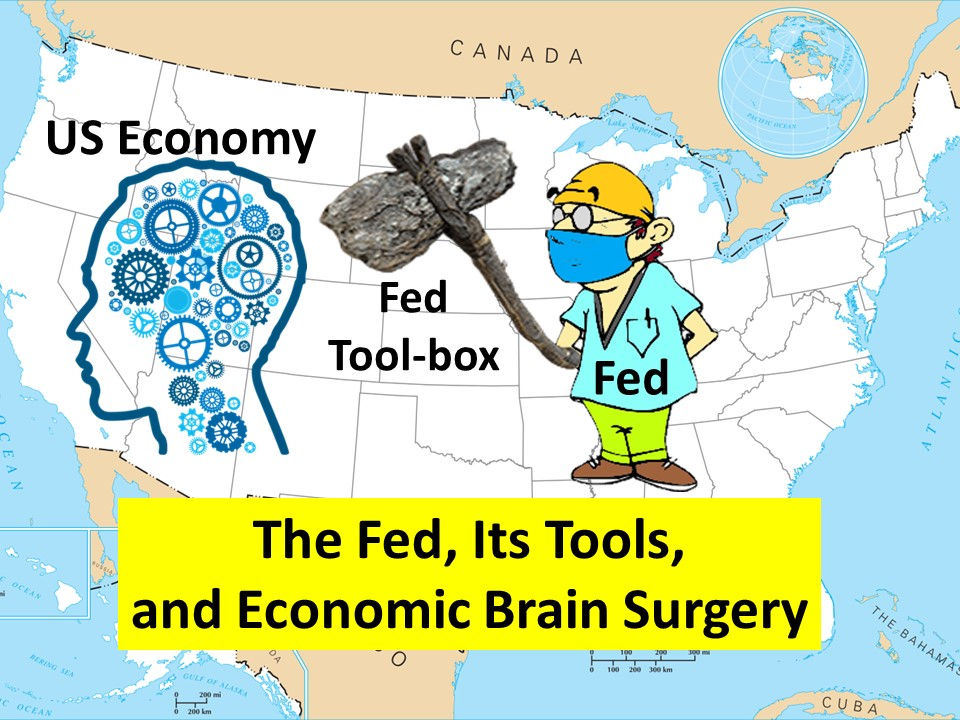
How likely is it that the two tools that the Fed has today: interest rate and money-supply are themselves up to the needs of today? These are rather crude and blunt tools to be sure. Our economy is much more complex and rapid today than it has ever been. Information that effects the market, businesses, governments, and the economy is virtually available instantly; but the tools for the Fed are still comparatively as slow as when they were created. If we compared managing the stability of the economy with brain surgery we might get an interesting picture. We would see that the economy’s brain has evolved more complexity (or our knowledge and understanding of it has vastly increased) that we must be aware of doing as little damage to as possible. We would expect that the surgeon (the Fed) who is to operate on the brain (Economy) has been trained and selected for their skills based upon the century of experience gained with the tools. But we would be surprised, if not outright shocked, to see that the surgeon is using the same crude implements that were available at the start of this art.
We might think to ourselves, “Why is a surgeon doing brain surgery with a stone-axe?“
And that is exactly the point.
Perhaps the nation should assess and consider updates to the Fed’s tool-box once every 100 years, or twice each century. There are plenty of ways to improve the basic tools the Fed has. There are additional tools that could be examined for adding capabilities that would enable the Fed to be more effective in keeping employment high and inflation acceptable. It is even possible that there might be an additional goal that the Fed would be well-suited for delivering to the betterment of the US Economy and the public. Our current experiences with COVID, global supply-chains, climate change, and a consumer-driven economy might just warrant being more forward-looking with regard to the Fed’s ability to respond with a scalpel rather than a stone-axe.


Comments